

How to calculate salary deduction for absent days: ÷26, ÷30 or ÷31?
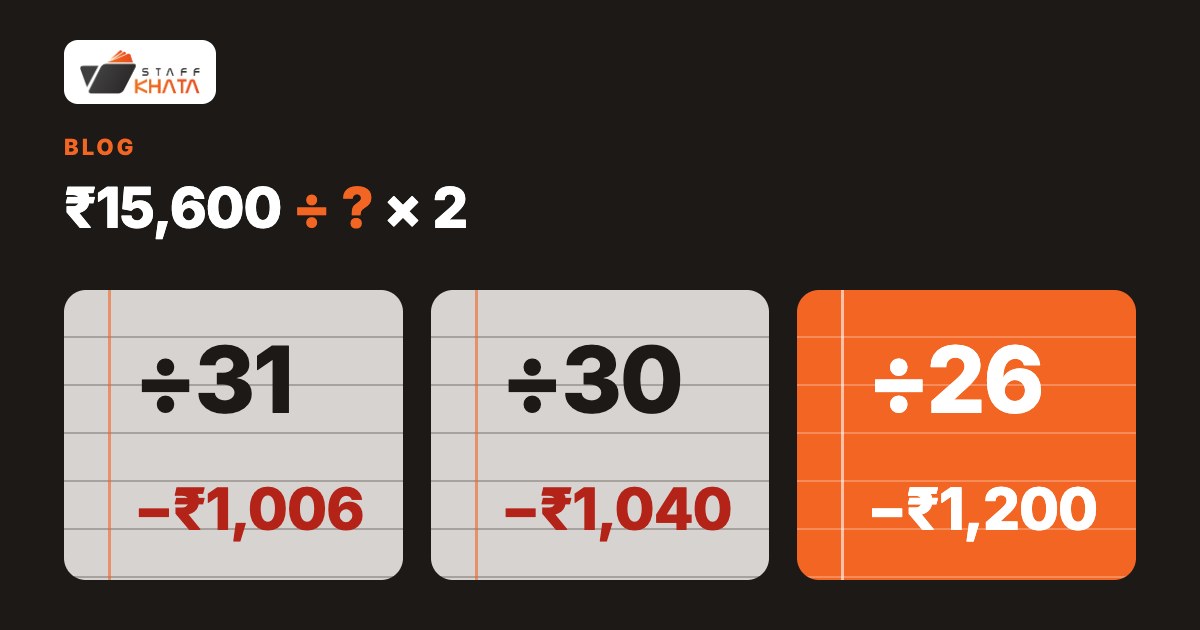
To work out the salary cut for a day off, divide the monthly salary by your pay basis (the calendar days in the month, a fixed 30, or 26 working days), then multiply by the days absent. On a ₹15,600 salary, 2 days off costs ₹1,006 (÷31 in October), ₹1,040 (÷30) or ₹1,200 (÷26). No law fixes one divisor. The Code on Wages does set a ceiling: an absence cut can never be a bigger share of the month's wages than the absent days are of the days the employee was required to work.
The three methods, worked out
Take one employee on ₹15,600 a month, with Sunday as the weekly off, who is absent for 2 days.
| Method | Per-day rate | Cut for 2 days | Who usually uses it |
|---|---|---|---|
| Calendar days (31 in October) | ₹503 | ₹1,006 | Shops and offices that want the cut to follow the month |
| Fixed 30 days | ₹520 | ₹1,040 | Businesses that want the same rate every month |
| 26 working days | ₹600 | ₹1,200 | Factories and shops that count only working days |
All three are in use, and none of them is wrong in itself. The difference is ₹194 on the same 2 days, and that is enough to start an argument on salary day. Pick one, write it in the appointment letter, and use the same method for every employee every month.
What does the law say about salary cuts for absence?
The Code on Wages, 2019 has been in force since 21 November 2025. It allows deductions "for absence from duty" (section 18), and section 20(2) limits how large they can be. The cut must not be a larger share of the wages for that period than the absent days are of the days the employee was required to work in that period. The Payment of Wages Act, 1936, which the Code replaced, had the same rule.
In practice, take October 2026, which has 31 days and 4 Sundays, so 27 working days for a six-day week. Two days absent is 2/27 of the required days, which caps the cut at ₹15,600 × 2 ÷ 27 = ₹1,156. A flat ÷26 cuts ₹1,200, which is ₹44 above that cap. In November 2026 there are 5 Sundays, so only 25 working days. The cap rises to ₹1,248, and ÷26 (₹1,200) stays under it.
If you use ÷26, check the result against the actual working days in months with only 4 Sundays. The calendar-day and fixed-30 methods always stay under the cap, because they divide by more days than anyone is required to work. Central and state rules under the Code were still being notified in 2026. This article is not legal advice, so check your state's rules or ask your CA if your policy differs.
November salary: two of the three methods give the same answer
November has 30 days, so "calendar days" and "fixed 30" both give ₹520 a day and a ₹1,040 cut for 2 days. The two methods differ only in 31-day months and in February. In a 28-day February, calendar days give ₹557 a day, so 2 days off cost ₹1,114.
Which method should you choose?
- Calendar days: fair to the month and simple to explain ("you were paid for 31 days and missed 2"). The cut changes slightly from month to month.
- Fixed 30: the same rate all year, which suits staff who check their salary against last month. It cuts a little more than calendar days in 31-day months and a little less in February.
- 26 days: matches how many factories think about a working month, and the same 15/26 logic is used for gratuity. It gives the highest cut per day, so check it against the legal cap above.
Whatever you choose, apply it the same way to unpaid leave and half days, and say it in writing before the first salary, not after a dispute.
How Staff Khata calculates it
Staff Khata's payroll uses the calendar-day method: monthly gross salary ÷ the days in your pay period, multiplied by the absent and unpaid-leave days it reads from attendance. If your salary period runs, say, from the 26th to the 25th, it counts the days in that period. On this method the per-day cut never goes above the working-day share in section 20(2). If your policy uses 26 or 30 days instead, the free per-day salary calculator shows all three figures side by side.
Frequently asked questions
Should I divide salary by 26 or 30 days?
Either is used in India, and neither is required for every employer. ÷26 gives a higher daily rate, so each absence costs more. ÷30 gives a lower rate. Choose one, put it in the appointment letter, and keep the cut within the section 20(2) share of working days.
Is the cut calculated on gross salary or basic?
For a monthly salaried employee, the absence cut is normally taken from the full monthly wage the employee would have earned, which is how Staff Khata calculates it.
How much is cut for one day off on ₹15,600?
₹503 in a 31-day month, ₹520 on a 30-day basis, or ₹600 on a 26-day basis.
Can I cut salary for a Sunday or a paid holiday?
Section 20 allows a cut only for absence from days the employee was required to work, and a weekly off or paid holiday is not one of those. If your policy treats an off day between two absences differently (a "sandwich" rule), write it in the appointment letter and check it with your CA.
More from StaffKhata
 Nov 14, 2026 • 5 min read
Attendance software that works with Realtime biometric machines
Connect a Realtime fingerprint or card machine to Staff Khata: live cloud punches, a QR option, offline alerts, and one free device on Starter.
 Nov 14, 2026 • 5 min read
Payslips with PF and ESI deductions, without hiring an accountant
Switch on PF and ESI, assign salary structures, run payroll from attendance and share payslip PDFs — how a small business does its own payroll in Staff Khata.
 Nov 14, 2026 • 6 min read
How to move from a paper attendance register to an app: 4 steps
Create a free account, add staff, pick a punch method and run both for a week: what changes from paper or Excel, whether staff need smartphones, data safety and what it costs.